When I led teams, one-to-ones did more to help me develop people than anything else.
Get them right and they're where the most useful conversations happen. Get them wrong and they're half an hour of nodding.
My colleague Dr Andy Hill, performance psychologist at Mindflick, summed up the risk: "It's really, really easy to confuse having the meeting with having communicated."
It's also common to hold regular one-to-ones, without seeing value from them. If that sounds familiar, read our guide on how to spot when your one-to-ones aren't working.
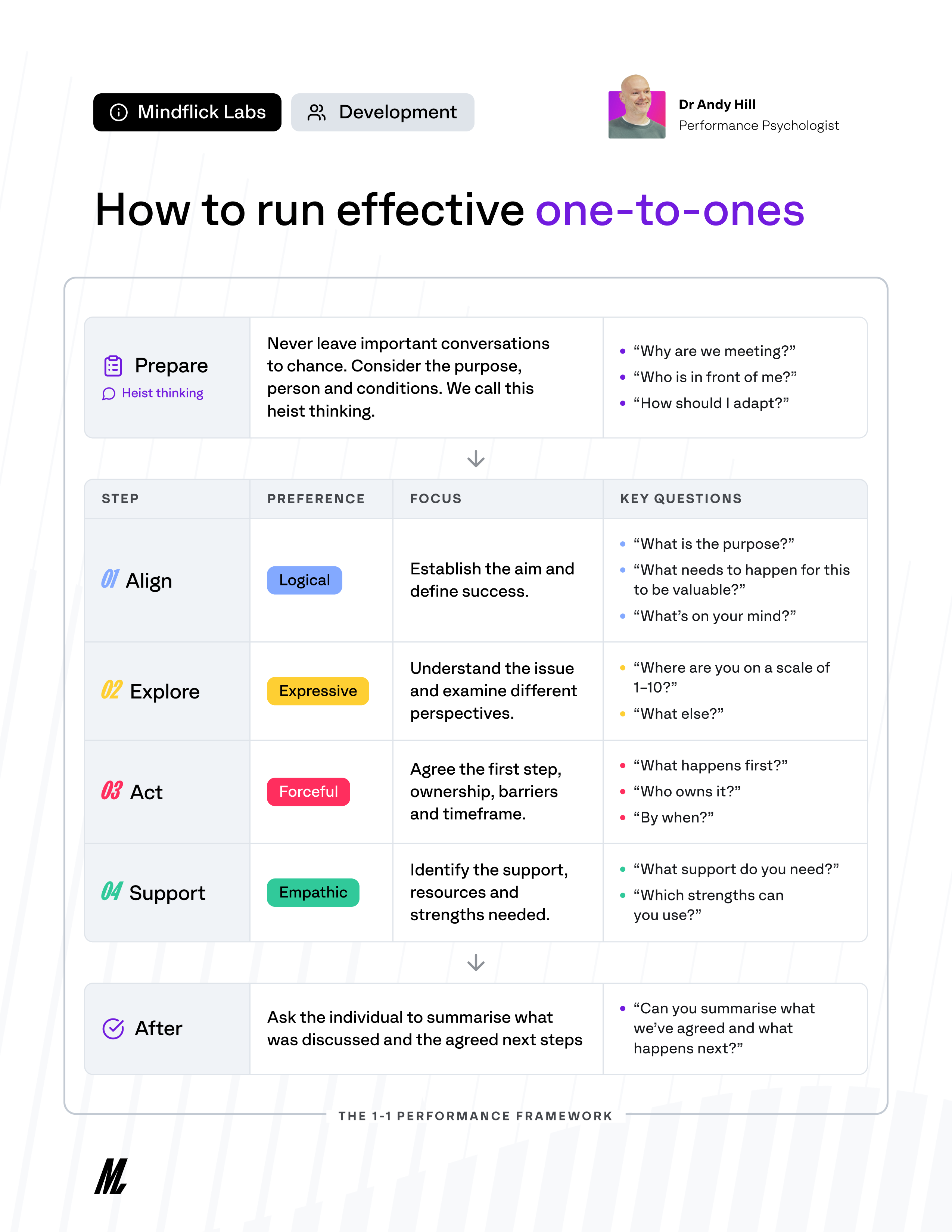
But ultimately a simple structure helps. So, we created The 1-1 Performance Framework, which Dr Andy Hill built around four steps: align, explore, activate and support. In this article we're going to share and explore that framework.
Before you start
If you were robbing a bank, you wouldn't do it spontaneously. "What you wouldn't do if you're trying to rob a bank is wander down the street and go, that bank over there looks quite quiet, let's go rob that now, shall we?"
Yet we often walk into one-to-ones exactly like that. What you need, Dr Andy Hill argues, is The Heist Mindset. Simply, never leave important conversations like one-to-ones to chance, so approach every conversation in the same way as a heist.
So book it in, know why you're meeting, and think about who will be sitting opposite you. Do they like to move fast? Do they care about detail? And what do they need to hear from you?
Step 1: Align
Start by being clear on the aim and establish what success looks like. Is this a progress check-in, a development chat, a performance conversation, or feedback? Then check your aim against what they need from it.
Try to approach this part of your conversation with a logical behavioural style. You're seeking answers and setting the foundations for the rest of the conversation.
Questions you can ask at this stage:
-
What is the purpose of this conversation?
- When your hand touches the door handle at the end of this one-to-one, what needs to have happened for this to have been a success for you?"
- "What's on your mind?"
The first is often called the door handle question, and it's my favourite. It gets people who haven't prepared much focused on what they need.
The second is what Andy calls the Facebook question: a warm, open invitation that works well for less formal check-ins.
If your aim and theirs don't match, say so now. It's far easier than finding out at the end.
Before we move onto Step 2, Performance psychologist Dr Andy Hill has covered this topic extensively in our masterclass: Why one-to-ones fall flat and how to fix yours. Watch it below to experience this framework from the experts themselves.

Step 2: Explore
Now open the topic up. At Mindflick we use a framework called COPE, which describes four mindsets, or ways of viewing the world. You don't need a Mindflick profile to use it.
Each mindset gives you a different angle, and asking from all four, in Dr Hill's words, "can give us a nice rounded view of the thing we're trying to explore."
-
Contained (calm, fact-based): What do we know? What are the facts?
-
Optimistic (confident, sees the upside): Where's the opportunity? What might pay off if we take a chance?
-
Prudent (careful, risk-aware): Where do we need to be careful? What should we think about first?
-
Engaged (instinctive, tuned in to change): What could change? How might we need to react?
We all lean towards one or two of these. Notice which questions you tend to skip, and ask those.
Here are additional questions you can ask at this stage in your one-to-one:
-
"And what else?" Ask it more than once. "If you keep going with that," Dr Hill said, "people will actually get to the crux of an issue quite quickly."
-
"On a scale of 1 to 10, where are we right now?" Then: "What would one point higher look like?" As Dr Hill put it: "Whatever number they give you, just go plus one."
This is the part of the one-to-one that should feel most like a coaching session. Ask, listen, and let them do most of the thinking.
Step 3: Activate
A great conversation that changes nothing is still a wasted one.
"We could theoretically talk about this forever," Dr Andy Hill adds, "but if we don't activate it, nothing happens." Leave time in the meeting to pin down what comes next.
Questions to ask:
-
What's the first step?
-
Who's accountable for it?
-
What might get in the way?
-
By when?
I'd never skip the last one. A date turns a good discussion into something that will actually happen, and it gives you both a natural point to check in.
How often you check in depends on the person. Dr Andy Hill's test is how often "you're going to need to check to see if we need to change." My own rule of thumb is to meet more often with someone who's struggling, or someone stepping up towards a promotion.
Dr Andy Hill adds new starters to that list. As they settle in, you can ease off, but "I would recommend signposting that to them so they don't feel like they're just being forgotten about."
Keep meeting when things are going well, too. Those conversations let you "really unpick what it is we're doing that's working really well, so we can make sure we keep doing it."
If you can't agree on an outcome
Sometimes the answer to the door handle question is huge and isn't something you can resolve in a single conversation.
When that happens, try agreeing a smaller aim for that day, even if it's just to understand the issue properly, and we pick up the rest next time.
The scaling question helps here too. As Dr Andy Hill notes, we're not asking how to get to 10 as fast as possible. "What we're saying is, what does a little bit better look like?"
Step 4: Support
The action belongs to them, but you can make it easier to deliver. Here are example questions you should ask at this step:
-
"What support will you need?" That might be time, a sounding board, or emotional support.
-
"What resources could help?"
-
"Which of your strengths can you use here?"
-
"Can you play back where we've got to and what happens next?"
The strengths question matters more than it looks. "We all have strengths," Dr Andy Hill adds. "Sometimes they're a lot harder for us to spot" in ourselves than others find them.
However, none of this works without trust. Dr Andy Hill describes a working relationship as an invisible rope between two people: "You spend a lot of time connecting that rope, establishing that rope, before you can start to use the rope and pull on it." Getting to know someone beyond their role is how you build it.
Being open about your own experience helps too. I once told someone in my team, in a casual chat, about a time I'd felt much less confident, and the things I'd said to myself back then. She looked at me and said, "You thought like that?"
As leaders, we've already walked that path, so the version of us in the meeting can look very sure of itself. Saying "I felt like that too" can make it much easier for someone to tell you what they need.
The playback question closes the loop. Dr Andy Hill's version is simple: "Just explain to me then where we're at in this conversation and what's going to happen next." If they can, you know it has landed. If they can't, you've found out in time.
Try it next time you're in a one-to-one
You don't need every question at once. In your next one-to-one, pick one question from each step of The 1-1 Performance Framework: the door handle question, "And what else?", "By when?" and the playback.
Four questions, and the conversation already has a shape. Plus, download the handy framework below, or watch Mindflick's Masterclass on running effective one-to-ones.

Anita Newton
Anita designs and delivers leadership, team and individual development programmes for clients in corporate, education and sport settings.